
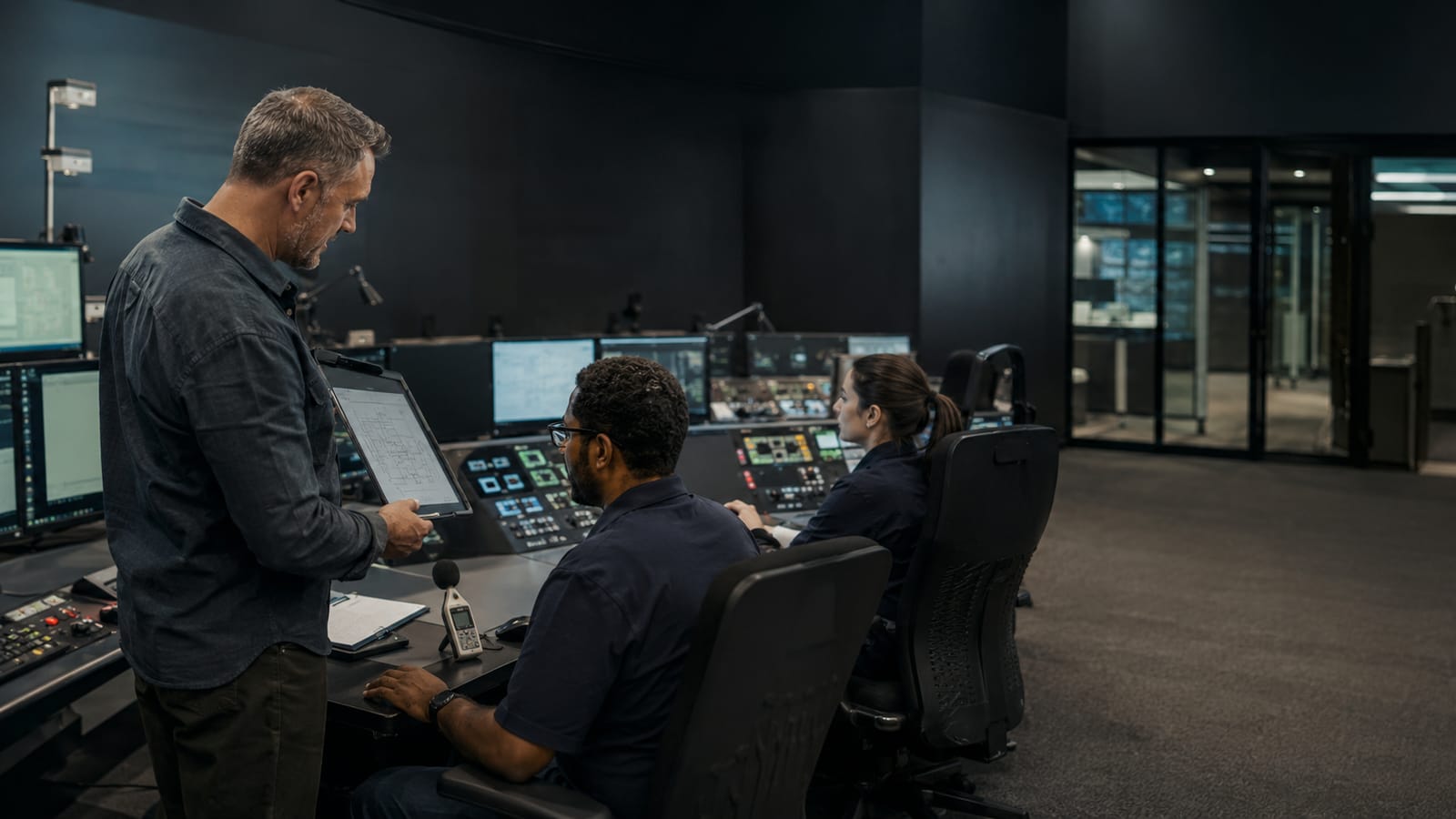
Every successful control-room project begins with understanding the operation. TechniHub assesses existing environments and defines the operational requirements that should drive future design.
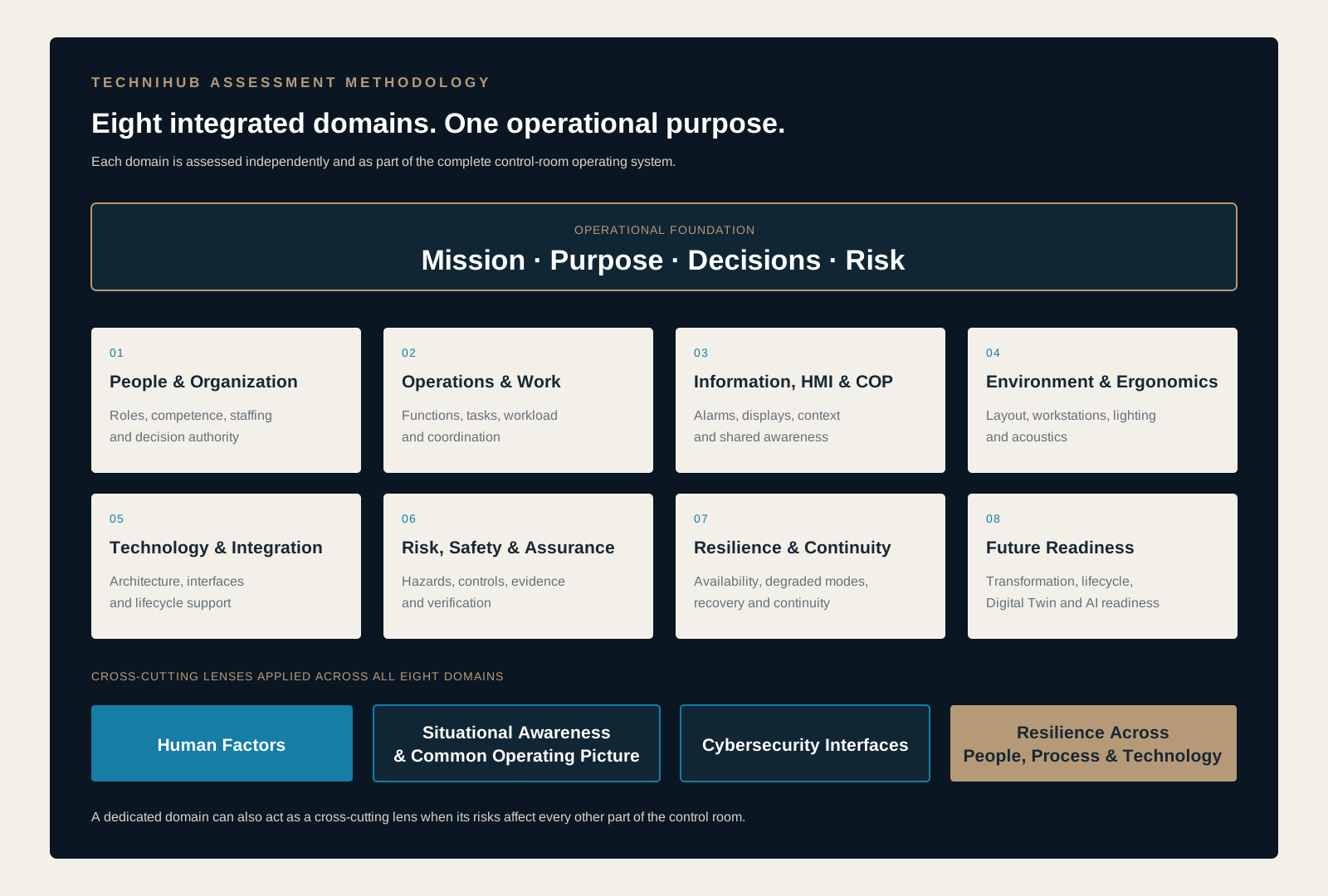
Eight interconnected dimensions of one control-room system — not a checklist of unrelated services.
Roles, responsibilities, staffing, competency, workload, fatigue and human performance.
Processes, procedures, workflows, communication and normal, abnormal and emergency operations.
Ergonomics, anthropometrics, cognitive workload, operator interaction and usability.
HMI, alarms, information hierarchy, visualization and situational awareness.
Layout, sightlines, lighting, acoustics, thermal conditions, circulation and accessibility.
Control systems, visualization, computing, communications, and control-room solution connectivity and interfaces with customer-provided infrastructure.
Control-room operational-continuity and supplied-system resilience requirements, coordinated with the responsible facility and infrastructure specialists.
Digital Twin, AI, analytics, automation, remote operations and scalability.
These eight dimensions are assessed together, as one interconnected operational system — not as isolated services.
Design & Engineering
Assessment findings and operational requirements become the foundation for a human-centered physical, information and technology environment.
Explore Design & Engineering →Human Factors & Ergonomics
A closer look at how workstation geometry, sightlines and workload shape operator performance.
Explore Human Factors →TechniHub defines and coordinates requirements for the control-room environment, control-room technology and the interfaces of systems within its contracted scope. Facility-wide IT/OT networks, enterprise cybersecurity, building services, structural engineering, fire and life-safety systems and process-control engineering remain the responsibility of the customer’s appointed qualified specialists unless separately contracted through an appropriately qualified specialist partner.
Understand where your control room stands today before defining its future state.